
Insights
Selected work: projects, articles and talks that show what I work on and how I think.
Science slam · Marine Environment Symposium · Hamburg 2026
Every goal is legitimate. That’s the problem.
Where better to show conflicting goals than at sea? Offshore wind, shipping, nature conservation and resource extraction all have legitimate claims to the same limited space. But not every goal can be met at once, let alone in full.
At the Marine Environment Symposium of Germany’s Federal Maritime and Hydrographic Agency (BSH), I tried to bring this dilemma into a format that was new to me: a science slam.
At its core is an uncomfortable question: does more and more data actually help us decide? Or does our constant call for even more knowledge contribute to decisions not being made at all? At some point, we also have to talk about priorities, societal values and institutional processes. And about how public institutions can keep their capacity to act under these conditions.
Commentary · SedNet · Madrid 2025
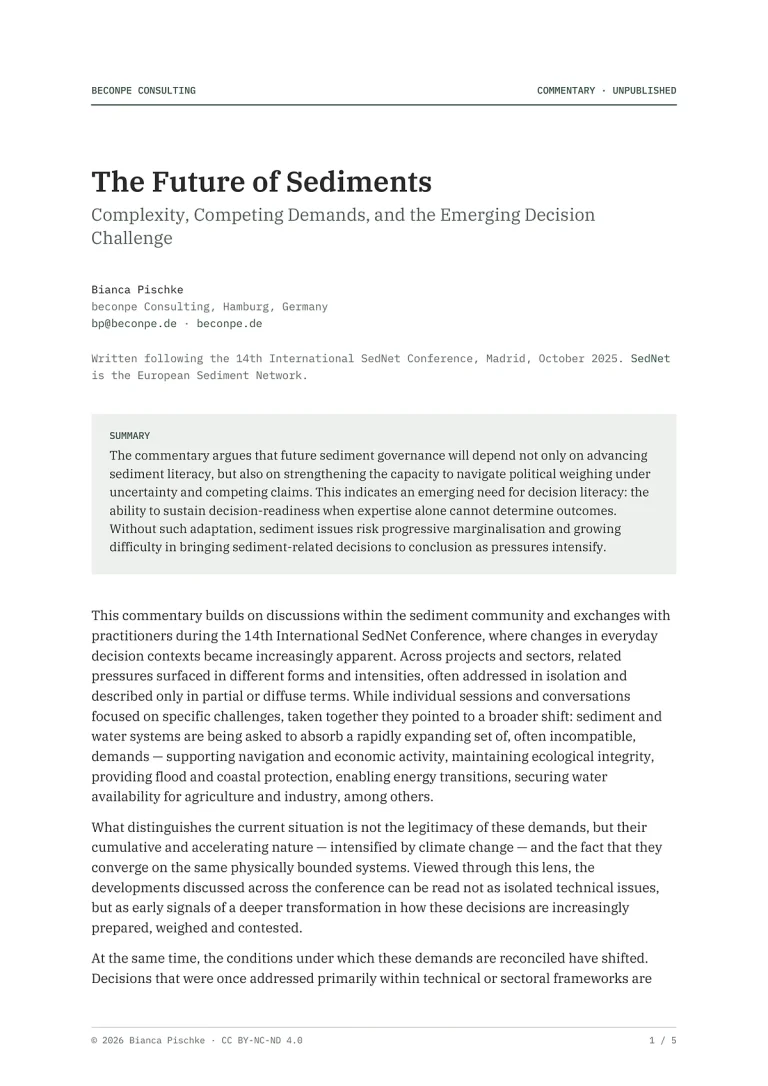
The Future of Sediments: Complexity, Competing Demands, and the Emerging Decision Challenge
The 2025 SedNet conference in Madrid, and above all the conversations with experts on the sidelines, made one development very clear: the demands on our rivers and coasts are growing, while it is becoming ever harder to reconcile different interests.
The commentary that grew out of this takes these observations as a reason to step back and look at the bigger picture. At its centre is a challenge that reaches beyond the technical questions of sediment management: how do institutions and societies remain able to decide and act when competing claims, political dynamics and growing complexity collide?
The commentary is meant as an invitation to discuss, and to disagree. The questions it raises, and possible ways forward, continue to occupy me, well beyond the sediment field.
Understanding Works
Our information landscape has changed fundamentally. Yet when it comes to sharing knowledge, we often still hold on to old principles. What does that mean for understanding, for responsibility and for our ability to act together?
With Understanding Works, I explore these questions on Instagram. The platform is my channel and, at the same time, part of the subject. Sometimes you have to step into the lion’s den to understand how something works.
More information does not automatically lead to more understanding. Let alone to better decisions.
Project ongoing ;)
Talk · SedNet · Madrid 2025
Sediment Literacy: Empowering Future Generations
Demands on river, coastal and marine systems are growing, and so are conflicts over their use. At the same time, AI and social media are changing how knowledge is created and how it reaches people, and polarising narratives often spread faster than understanding. My contribution to the conference of SedNet, the European Sediment Network, asks what this means for how we manage natural resources: for the capacity of decision-makers to act, and for a democracy in which people can take part in an informed way.
At its centre is sediment literacy, a basic understanding of the role of sediments in river, coastal and marine systems. This calls for institutions that make knowledge accessible and put it into context, for good examples from international risk communication, and for a critical look at what AI and social media can contribute.
The abstract was published in the conference’s book of abstracts. I’m happy to talk you through the slides on request.
First published 2009, reprinted 2012
ISBN 978-602-9105-21-6
Guidebook · Indonesia
Which risks do we accept?
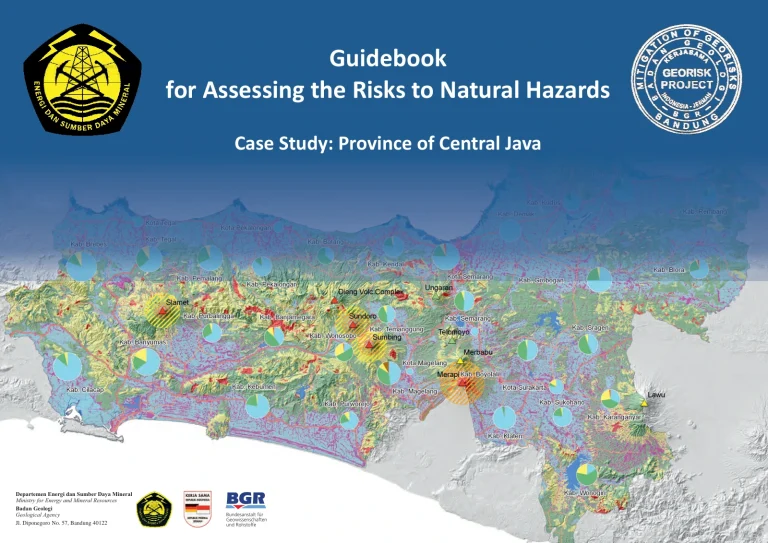
Earlier in my career, I worked for the German Federal Institute for Geosciences and Natural Resources (BGR) as part of a German-Indonesian team assessing natural hazards and risks, later also as project lead. This guidebook for Central Java is one of our joint publications.
The questions from back then are just as relevant to me today: with more and more data, risks can be described ever more precisely. But how does that turn into concrete measures? How do institutions set priorities together, weigh different interests and make sure the results actually reach people?
The guidebook is available on PreventionWeb, a valuable resource for anyone working on disaster risk reduction.
Working on similar questions and looking for support? Let’s talk.